



Firestopping Systems: Protecting Every Penetration, Preserving Every Compartment
Behind every fire-resilient building is an invisible network of firestopping systems that protect the integrity of fire-rated walls and floors. Although often concealed within the building fabric, these systems are essential for preventing the spread of flames, smoke, and toxic gases through service penetrations. As modern buildings become increasingly dependent on complex mechanical, electrical, and communication services, firestopping has emerged as one of the most critical components of passive fire protection.
Modern buildings are designed to accommodate an extraordinary number of services that support everyday operations. Electrical power, communication networks, plumbing, medical gas pipelines, air-conditioning ducts, sprinkler systems, fibre-optic cables, security installations, and automation infrastructure all pass through walls, floors, and ceilings to connect different areas of a building. While these systems are essential for functionality, every opening created for a pipe, cable, or duct also represents a potential weakness in the building's passive fire protection strategy. A fire-rated wall or floor is engineered to resist fire for a specified period, but its effectiveness can be severely compromised if service penetrations are left unprotected. Even a relatively small opening around a cable bundle or plastic pipe can become a direct pathway for flames, smoke, and hot gases, allowing a localised fire to spread rapidly throughout the building. This is where firestopping becomes indispensable.
Firestopping is the process of restoring the fire resistance of walls and floors after they have been penetrated by building services. It involves the use of specially tested and certified systems designed to prevent the passage of fire, smoke, and heat through these openings during a fire emergency. Unlike conventional construction sealants or fillers, firestopping products are engineered to perform under extreme temperatures and are tested as complete systems to ensure they maintain the required fire resistance rating. Their role is not only to seal an opening but also to preserve the integrity of the building's compartmentation strategy, ensuring that fire remains confined to the area of origin for a sufficient period to allow safe evacuation and effective firefighting operations.
The importance of firestopping has grown significantly with the evolution of modern construction. Contemporary buildings contain far more mechanical and electrical services than structures built just a few decades ago. Hospitals rely on extensive medical gas networks, airports require sophisticated communication and control systems, data centres house thousands of cables serving mission-critical digital infrastructure, and commercial buildings are equipped with intelligent automation technologies that require continuous connectivity throughout the structure. Every one of these installations introduces additional penetrations through fire-rated barriers, increasing the number of locations where compartmentation could potentially fail. Consequently, firestopping has evolved from a specialist installation activity into a critical engineering discipline that demands careful planning, product selection, installation, and lifecycle management.
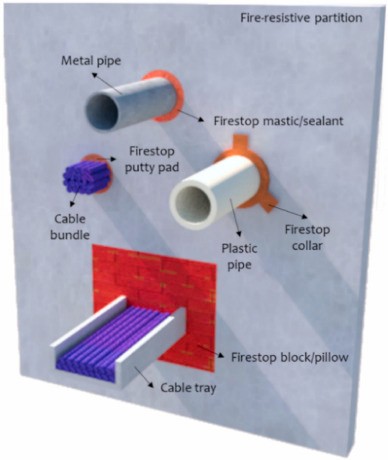
One of the greatest misconceptions surrounding firestopping is that any sealant capable of filling an opening will provide adequate fire protection. In reality, firestopping systems are carefully engineered combinations of materials designed to perform in specific construction assemblies under defined fire conditions. The performance of a firestop depends not only on the sealant itself but also on the type of wall or floor, the material passing through the opening, the size of the annular gap, the orientation of the penetration, and the installation method. Firestop sealants, intumescent collars, wraps, modular transit systems, mortars, pillows, and preformed blocks each serve different purposes and are selected according to the characteristics of the penetration they are protecting. Substituting one product for another without proper testing or certification can significantly reduce the effectiveness of the entire fire barrier.
Plastic pipes present one of the most challenging firestopping applications. During a fire, thermoplastic materials soften and eventually melt, leaving large openings through which flames and smoke can pass freely. Fire collars address this problem by incorporating intumescent materials that expand rapidly when exposed to heat. As the plastic pipe softens, the expanding material crushes the pipe and seals the resulting opening, maintaining the integrity of the compartment wall or floor. Similar principles apply to fire wraps used around combustible pipes in confined spaces, where traditional collars may not be practical. These technologies demonstrate how passive fire protection systems actively respond to changing fire conditions despite requiring no external power or mechanical activation.
Unfortunately, many building inspections continue to reveal deficiencies in firestopping installations. Service upgrades carried out after construction frequently involve the addition of new cables or pipes without reinstating the original firestop system. Maintenance personnel may remove firestop materials to access services and fail to replace them correctly. In some cases, contractors use general-purpose construction sealants rather than certified firestop products, unaware that these materials provide little or no protection during a fire. Poor workmanship, inadequate supervision, lack of documentation, and insufficient coordination between mechanical, electrical, and fire protection contractors further contribute to compromised compartmentation. These seemingly minor deficiencies have been identified as contributing factors in numerous fire investigations worldwide, highlighting the need for greater awareness, training, and quality assurance.
The future of firestopping is increasingly influenced by digital technologies and smarter building management practices. Building Information Modelling (BIM) enables designers to identify every penetration requiring protection before construction begins, while digital asset management systems allow facility managers to monitor the condition of firestop installations throughout a building's lifecycle. QR-coded labels, cloud-based inspection platforms, and electronic maintenance records are replacing traditional paper documentation, improving traceability and supporting regulatory compliance. At the same time, manufacturers continue to develop environmentally responsible firestop products with lower emissions, improved durability, and greater flexibility to accommodate the evolving needs of modern construction.
Although firestopping is rarely visible once a building is completed, its contribution to fire safety cannot be overstated. Every properly protected penetration reinforces the effectiveness of fire compartmentation, helping to contain fire where it starts, preserve escape routes, protect critical infrastructure, and reduce the extent of property damage. In an era where buildings are becoming more technologically sophisticated and densely serviced than ever before, firestopping represents one of the most important investments in passive fire protection. It is the unseen safeguard that ensures every wall, floor, and compartment performs exactly as intended when lives and assets depend on it.